Showing posts with label subic bay. Show all posts

Monday, August 1, 2011

dewey drydock 1906


From 28 December 1905 - 9 July 1906 she underwent the greatest sea-towing feat of it's day. It took four ships to tow the Dewey Dry-dock 12,000 miles from the U.S. East coast across the Atlantic, into the Mediterranean Sea, through the Suez Canal, Red Sea and into the Indian Ocean and ending the journey at Olongapo, Luzon, Philippines.

original subic drydock
http://freepages.military.rootsweb.ancestry.com/~cacunithistories/Dewey_Drydock.html


1942 start of construction in five different shipyards around USA. the construction was top secret like the making of atomic bomb. it was the original "transformer" and "voltes 5" design as we know it today.
1943 commisioned


1951 towed from pearl to guam
1952 operational in guam


http://abitabout.com/Philippine+Navy

http://chinamarine.org/Philippines.aspx

Machinist (AFDB-8)

AFDB-8 Class Large Auxiliary Floating Dry Dock :
  • Built, in 1980, by Seebeck, Shipbuilding GmbH, Bremerhaven, Germany
  • Delivered and placed in service in June 1980 as Machinist (AFDB-8)
  • Allocated to Naval Base Subic Bay, Philippines
  • Placed out of service, circa 1992
  • Struck from the Naval Register, 23 April 1997
  • Sold, 23 April 1997, for commercial service to Guam Industrial Services Shipyard


  • Specifications:
    Displacement unknown
    Length 825'
    Beam 175'
    Draft unknown
    Complement unknown
    Armament none

    Click On Image
    For Full Size Image
    SizeImage DescriptionContributed
    By
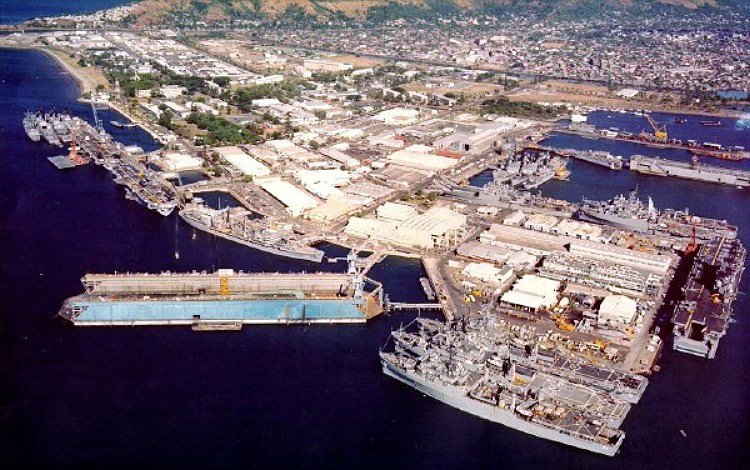
    Machinist127kMachinist (AFDB-8) at Naval Station Subic Bay, Luzon, Philippines, date unknown.Bob Gregory YA-03
    WESTPAC Maintenance PMgr.
    Berthing & Messing PMgr.
    COMPACFLT N433
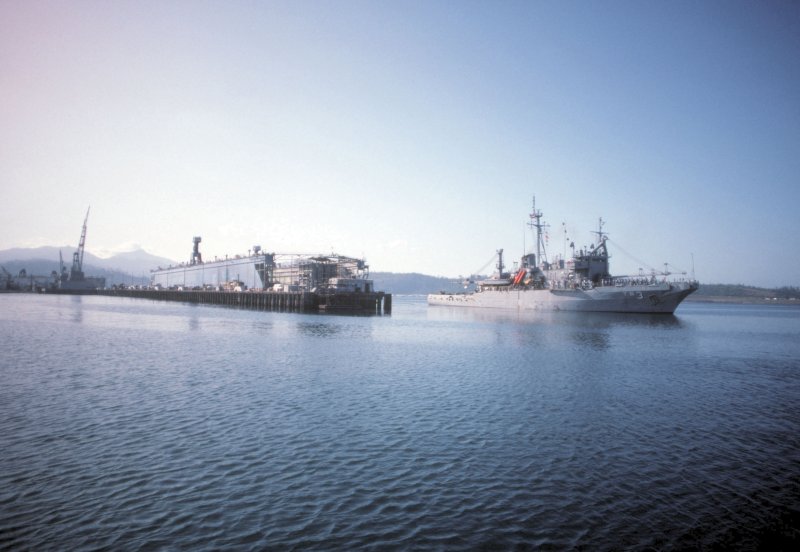
    Machinist62kMachinist (AFDB-8) and USS Brunswick (ATS-3) at Naval Station Subic Bay, Luzon, Philippines, 3 April 1992. Brunswick towed Machinist from Subic Bay to Pearl Harbor during the US military withdrawal from Subic Bay.
    DOD photo # DNST9207048 by Roger Dutcher, JO2 USN.
    Defense Imagery.mil
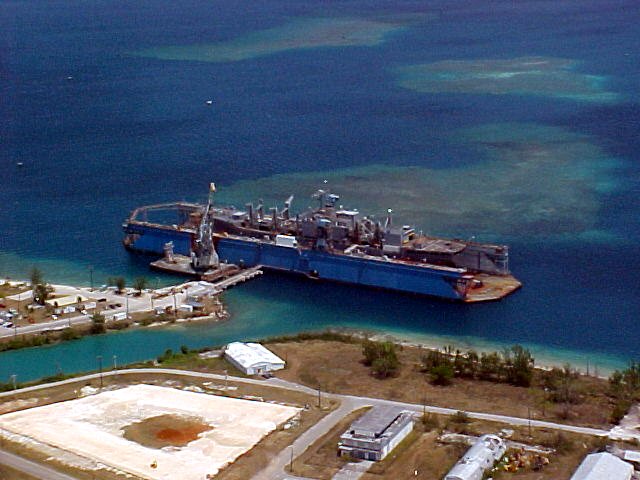
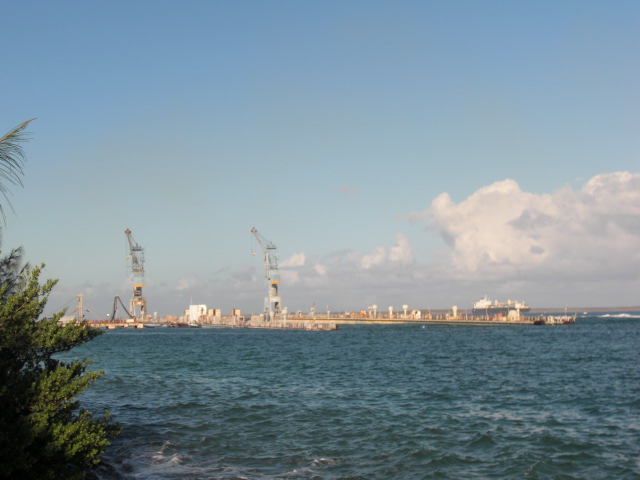
    Machinist69kAerial view of ex-Machinist (AFDB-8) in commercial service for Guam Ship Yard, Apra Harbor Guam, circa 2008.Bob Gregory
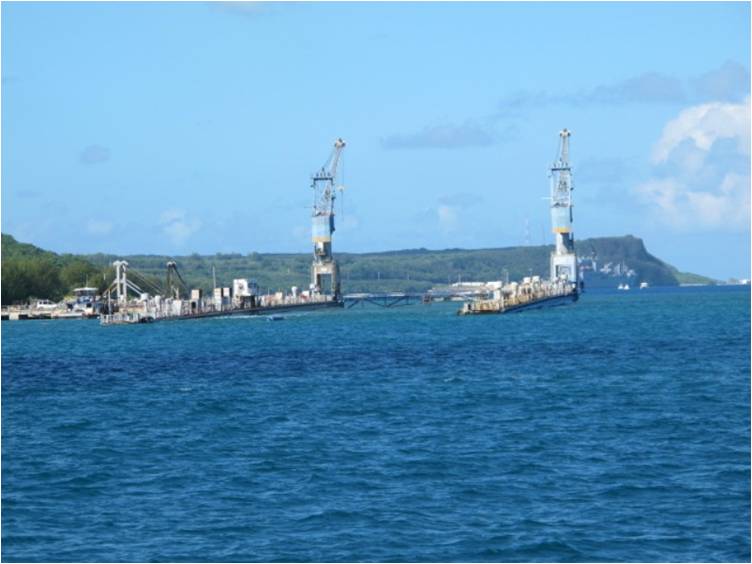
    Machinist45kEx-Machinist (AFDB-8) sunk at Guam Ship Yard, Apra Harbor Guam, January 2011.
    Machinist10


  • USS Artisan (ABSD-1) AFDB 1


    USS Artisan (ABSD-1), a ten-section, non-self-propelled, large auxiliary floating drydock, was the only ship of the United States Navygiven this name. She was constructed in sections during 1942 and 1943 by the Everett Shipbuilding Company, in Everett, Washington; the Chicago Bridge & Iron Company, in Eureka, California; the Pollack-Stockton Shipbuilding Company, in Stockton, California; and the Chicago Bridge & Iron Company, in Morgan City, Louisiana. Her official commissioning ceremony took place at Everett, Washington, on 10 May 1943, Captain Andrew R. Mack in command.

    USS Artisan (ABSD-1) with Antelope (IX-109) and LST-120 in the dock at Espiritu Santo, New Hebrides Islands, 8 January 1945

    USS Artisan (ABSD-1) with Antelope (IX-109) and LST-120 in the dock at Espiritu Santo, New Hebrides Islands, 8 January


    Career (US)
    Laid down:1942 and 1943
    Commissioned:10 May 1943
    Decommissioned:1 March 1987
    Struck:1 March 1987
    Reinstated:March 1987
    Honors and
    awards:

    American Campaign Medal ribbon.svg American Campaign Medal Asiatic-Pacific Campaign ribbon.svg Asiatic-Pacific Campaign Medal World War II Victory Medal ribbon.svg World War II Victory Medal National Defense Service Medal ribbon.svg National Defense Service Medal

    Fate:Sections A,G,H,I sold for scrapping 1 March 1987
    Section B and E laid up at NISMF, Pearl Harbor, 1 March 1987
    Section F disposed of as a target, 1 March 1987
    Section C redesignated IX-525, 2 March 1998, status, active in service
    Section D redesignated IX-521, 16 August 1996, status, active in service at NISMF Pearl Harbor, HI.
    General characteristics
    Displacement:38,500 (in ten sections)
    Length:927 ft (283 m) (in ten sections)
    Beam:256 ft 0 in (78.03 m)
    Draught:9 ft (2.7 m) floated, 78 ft (24 m) flooded
    Speed:not self-propelled
    Capacity:90,000 tons lift
    Complement:690 officers and men
    Armament:none

    War service

    The floating drydock made the voyage to the southwestern Pacific in two separate convoys. The two sections constructed on the Gulf Coast departed Morgan City, Louisiana, on 14 July 1943, while the remaining eight sections concentrated at San Francisco, California, before putting to sea on 28 August 1943. The first two sections arrived at Espiritu Santo in the New Hebrides on 24 September, and the West Coast sections reached that destination on 2 October. Later that month, the drydock's crew began assembly procedures. On 2 November in the course of assembling the drydock, one of its sections sank, drowning 13 of her crew. By the end of 1943, she was a working drydock of eight sections repairing a variety of Navy ships at Espiritu Santo. In April 1944, ABSD-1 became a full ten-section drydock when her remaining section was combined with another from ABSD-2 and was joined to the eight already functioning. With all ten sections joined, she was 927 feet long, 28 feet tall (keel to welldeck), and with an inside clear width of 133 feet 7 inches.

    She served in the New Hebrides until mid-April 1945 at which time she received orders to disassemble and move forward to the big base atLeyte Gulf in the Philippines. ABSD-1 completed disassembly by the beginning of June and, on 30 June, the first six sections began the voyage, via Hollandia, New Guinea, to Leyte. The remaining four sections took departure on 7 July. The first echelon arrived at Manicani Bay, Samar Island, on 27 July, and assembly began three days later. On 2 August, the rest of the drydock entered Manicani Bay and, by mid-September, all ten sections had been joined together. The floating drydock resumed her repair work soon thereafter, and it continued through February 1946. On 28 February 1946, she undocked four yard craft and began preparations for inactivation. ABSD-1 was decommissioned on 31 May 1946.

    [edit]Post-war service

    She remained in the Philippines through the summer and fall of 1946. During that time, in August 1946, the advanced base sectional dock was reclassified a large auxiliary floating drydock and was redesignated AFDB-1. Sometime after November 1946, her sections were towed from the Philippines to Pearl Harbor where they were placed in reserve. Her inactivity lasted almost exactly five years. She was recommissioned at Pearl Harbor on 2 June 1951, Captain O. J. Stien, USNR, in command. Later that month, she was towed, in sections, to Guam in the Mariana Islands where the Navy was improving another repair facility in fairly close proximity to the combat zone in the year-old Korean War. Reporting for duty on 26 June 1951, she was not completely assembled and ready for duty until the beginning of March 1952.

    Active at Apra Harbor not quite three years, AFBD-1 was out of commission again and back in reserve by January 1955. She remained inactive at Guam for a little more than 15 years. In 1970, five of her sections were moved to Subic Bay in the Philippines where the floating drydock was placed in service once again on 17 November 1970. Her third period of active service proved to be her longest lasting almost 16 years. On 7 June 1979, she was named Artisan. In October 1986, Artisan was placed out of service, and her name was struck from the Naval Vessel Register. In March 1987, however, Artisanreceived a reprieve when her name was reinstated on the Naval Vessel Register.

    On 16 August 1996 her Section 1D was reclassified as unclassified miscellaneous vessel IX-521, and on 2 March 1998 her Section 1C was reclassified to IX-525.


    Image gallery


    Tuesday, April 1, 2008

    Subic Drydock Corp Ready to Take on More Customers

    Subic Drydock Corporation (SubicDock), a company providing ship repair and new building services in this free port, is now ready to take on more customers following its acquisition of another drydocking facility.

    SubicDock president Catalino Bondoc said the firm recently acquired the AFDL-21, a small auxiliary floating dry dock, and has installed it at Subic's Bravo Pier alongside the AFDM-5, a medium auxiliary floating dry dock, that the firm brought here last year.

    The SFDL-21, which has a length of 200 feet and a beam of 64 feet, has a lifting capacity of 1,000 tons, while the bigger AFDM-5, which has an overall length of 622 feet and an extreme beam of 124 feet, can lift vessels up to 1,000 tons.

    "With these two dry docks, we are now able to serve a wider range of vessels and aim to be one of the leaders in the Philippine ship repair industry," Bondoc said during a familiarization tour for shipping agents and prospective clients.

    "Our company vision," Bondoc added, "is to be a world-class provider of ship repair, overhauling, installation, fabrication, and port general services."

    SubicDock brought the AFDM-5 to its former home in Subic last year after serving at the Guam Shipyard since 1992, when the US Navy towed the dry dock to Guam as it pulled out from the former Subic Naval Base.

    The AFDL-21, meanwhile, was transferred to the Philippine Navy in 1961, but was sold to Malayan Towage and Salvage Corp. in March 1990. It has been operating here since October last year.

    SubicDock has been attracting a growing list of customers, including vessels owned by the US Navy, the North Korean fishing fleet, and Austel Shipping, an Australian firm operating high speed ferries.

    The firm has received a 2001 certification of compliance from the RINA Society (Registro Italiano Novale) of Italy, Bondoc said.

    Subic Bay Metropolitan Authority (SBMA) Chairman Feliciano Salonga, who attended the recent briefing, said SubicDocks ship repair facilities boost Subics bid to become a major international maritime center.

    "We've got it all here," Salonga said. "Subic has a deep, natural harbor for ships, tax-free environment for business, and skilled but comparatively cheap manpower."

    Bondoc said SubicDock is a wholly-owned subsidiary of Cabras Marine Corporation, a US-based maritime services organization with over 30 years experience in providing tugboat, salvage, pilot age and waterfront services for the US Navy and commercial ocean-going vessels in Guam and Micronesia.

    With the company now in the final stages of completing requirements for ISO 9001:2000 certification, Bondoc said that SubicDock's clients could be assured of the firms capabilities in technical and client support services, ship repair, customer assurance, and on-time product delivery.

    Aside from drydocking facilities, Bondoc said SubicDock also has a 100-ton floating derrick crane and all the necessary shop facilities and equipment for various operations and services.

    The company also offers comprehensive ship repair, conversion and construction, engineering, mechanical and electrical repair, tugboat and barging services, non-destructive testing, welding, painting and coating services, structural fabrication and lay out, manufacturing and machining, and component refurbishment.

    SubicDock also undertakes valves-in shop services, shipboard mechanical and component and valve repairs, governor and injector services, internal combustion engine services, hydraulic services, piping system services, heat exchanger and cooler services, air conditioning and refrigeration, insulation, shipwright and woodworking, temporary services, electric and electronic services, crane rigging, transportation, maintenance, testing and certification, diving services, and occupational health, safety and environmental services.

    (PNA)